Description
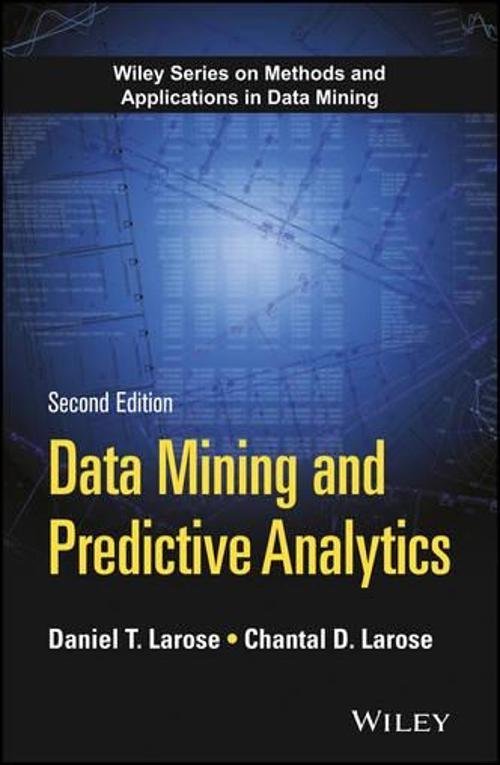
This updated second edition serves as an introduction to data mining methods and models, including association rules, clustering, neural networks, logistic regression and multivariate analysis. The authors apply a unified ?white box? approach to data mining methods and models. This approach is designed to walk readers through the operations and nuances of the various methods, using small data sets, so readers can gain an insight into the inner workings of the method under review. brbr?Data Preparation br?Statistical Analysis br?Classification br?Clustering br?Association Rules br?Enhancing Model Performance br?Further Topics brb About the Author/bDaniel T. Larose is Professor of Mathematical Sciences and Director of the Data Mining programs at Central Connecticut State University. In addition to his scholarly work, Dr. Larose is a consultant in data mining and statistical analysis working with many high profile clients, including Microsoft, Forbes Magazine, the CIT Group, KPMG International, Computer Associates and Deloitte, Inc.Chantal D. Larose is a candidate in Statistics at the University of Connecticut. Her research focuses on the imputation of missing data and model-based clustering. She has taught undergraduate statistics since 2011 and is a statistical consultant for DataMiningConsultant.com, LLC./pbrbrstrongTable of Contents: /strongbrPreface Acknowledgments Part I Data Preparation Chapter 1 An Introduction to Data Mining and Predictive Analytics 1.1 What is Data Mining? What is Predictive Analytics? 1.2 Wanted: Data Miners 1.3 The Need for Human Direction of Data Mining 1.4 The Cross-Industry Standard Process for Data Mining: CRISP-DM 1.5 Fallacies of Data Mining 1.6 What Tasks Can Data Mining Accomplish Chapter 2 Data Preprocessing 2.1 Why do We Need to Preprocess the Data? 2.2 Data Cleaning 2.3 Handling Missing Data 2.4 Identifying Misclassifications 2.5 Graphical Methods for Identifying Outliers 2.6 Measures of Center and Spread 2.7 Data Transformation 2.8 Min–Max Normalization 2.9 Z-Score Standardization 2.10 Decimal Scaling 2.11 Transformations to Achieve Normality 2.12 Numerical Methods for Identifying Outliers 2.13 Flag Variables 2.14 Transforming Categorical Variables into Numerical Variables 2.15 Binning Numerical Variables 2.16 Reclassifying Categorical Variables 2.17 Adding an Index Field 2.18 Removing Variables that are not Useful 2.19 Variables that Should Probably not be Removed 2.20 Removal of Duplicate Records 2.21 A Word About ID Fields Chapter 3 Exploratory Data Analysis 3.1 Hypothesis Testing Versus Exploratory Data Analysis 3.2 Getting to Know the Data Set 3.3 Exploring Categorical Variables 3.4 Exploring Numeric Variables 3.5 Exploring Multivariate Relationships 3.6 Selecting Interesting Subsets of the Data for Further Investigation 3.7 Using EDA to Uncover Anomalous Fields 3.8 Binning Based on Predictive Value 3.9 Deriving New Variables: Flag Variables 3.10 Deriving New Variables: Numerical Variables 3.11 Using EDA to Investigate Correlated Predictor Variables 3.12 Summary of Our EDA Chapter 4 Dimension-Reduction Methods 4.1 Need for Dimension-Reduction in Data Mining 4.2 Principal Components Analysis 4.3 Applying PCA to the Houses Data Set 4.4 How Many Components Should We Extract? 4.5 Profiling the Principal Components 4.6 Communalities 4.7 Validation of the Principal Components 4.8 Factor Analysis 4.9 Applying Factor Analysis to the Adult Data Set 4.10 Factor Rotation 4.11 User-Defined Composites 4.12 An Example of a User-Defined Composite Part II Statistical Analysis Chapter 5 Univariate Statistical Analysis 5.1 Data Mi